
Understanding GSTAT: Everything You Need to Know About GST Appeals in 2026
Simplify your taxes with Dileep Gupta Tax Firm, your trusted Tax Matters Consultant. We offer expert tax filing, compliance, and planning solutions tailored to your needs. Save time, reduce stress, and avoid costly errors—book your consultation today!
4/8/20265 min read

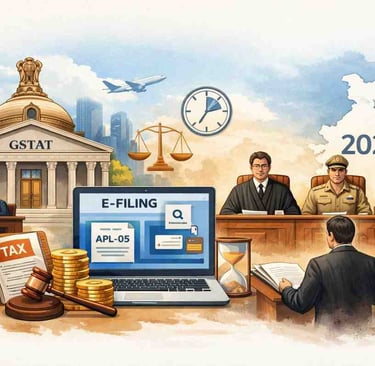
If you are a business owner in India, you likely know that the GST journey has been full of "show-cause notices" and "orders" that often seem unfair. For years, taxpayers were stuck because there was no specialized court to hear their second appeals.
As of early 2026, that has changed. The Goods and Services Tax Appellate Tribunal (GSTAT) is now fully operational, providing a dedicated platform to challenge incorrect tax demands. At Dileep Gupta Tax Firm, acting as a veteran tax matters consultant, we have spent over 25 years navigating the complexities of tax litigation, and we are here to help you understand how this new system protects your business rights.
What is GSTAT and Why is it Essential for Your Business?
The Goods and Services Tax Appellate Tribunal (GSTAT) is technically the "Second Appellate Authority" established under Section 109 of the CGST Act. Think of it as a specialized court designed specifically to handle GST disputes. Before GSTAT was active, businesses had to go to the High Court for every small dispute, which was both expensive and time-consuming.
An appeal under GST is now a more structured process. GSTAT functions as a "Fact-Finding" body, which is a critical distinction for laymen to understand. While the High Court primarily looks at "Questions of Law," GSTAT is the last place where you can present physical evidence, bills, and ledgers to prove your case. If you miss proving a fact at this stage, you cannot bring it up later in a higher court. This makes GSTAT the ultimate destination for relief in various tax assessment appeals.
This process usually begins once you receive an Order-in-Appeal (OIA). This is the decision given by the first officer who heard your case. If you are unhappy with this result, GSTAT is your next destination for relief.
How Does the GST Appeal Procedure Work in 2026?
Navigating the GST appeal procedure requires a mix of digital filing and physical verification. Since the 2026 rollout, the process has been streamlined through the GSTAT e-filing portal, necessitating expert tax representation services to ensure faster resolutions and avoid procedural rejections.
The 5-Step GSTAT Filing Framework:
The 3-Month Window: You must file your appeal within 90 days of receiving your Order-in-Appeal.
Pre-deposit (The "Security Deposit"): To ensure only genuine cases reach the judge, you must pay an additional 10% of the disputed tax amount (on top of the 10% paid during your first appeal).
Online Filing: You must fill out Form GST APL-05 on the official portal, attaching all supporting documents.
The 7-Day Rule: Once filed online, a "certified copy" of the order you are challenging must be submitted to the GSTAT Registrar within 7 days.
The Hearing: A bench consisting of one Judicial Member (a legal expert) and one Technical Member (a tax department expert) will hear your advocate’s arguments.
Can I Appeal Old Cases from 2017–2020 Now?
Yes. This is one of the most beneficial updates for taxpayers in 2026. For years, many businesses had received unfavorable orders but had nowhere to appeal.
The government has opened a "Golden Window" until June 30, 2026. During this period, you can file an appeal for any order issued between 2017 and 2025 that you were unable to challenge due to the absence of the Tribunal. While many consultants advise waiting until the deadline, the massive backlog of 4 lakh cases means those who file early in 2026 will get their hearings much faster. Delaying your filing could mean your case stays pending for years.
This window also includes cases related to a service tax appeal if they were transitioned into the GST era and are currently under dispute.
Why Do You Need a Tax Advocate for GSTAT?
While a CA or a taxpayer can theoretically file an appeal, GSTAT is a judicial body. The environment is similar to a courtroom, not a tax office. This is where Tax Litigation Support from an experienced advocate becomes indispensable.
The difference lies in the shift from compliance to litigation. Filing a return is about math, but winning an appeal is about law. In GSTAT, your representative may need to cross-examine the technical findings of a GST officer. This requires legal training and an understanding of "Evidence Law."
An advocate like Dileep Gupta, with 25+ years of experience, knows which Supreme Court or High Court judgments will force the Tribunal to rule in your favor. At Dileep Gupta Tax Firm, we provide comprehensive tax litigation support; we don't just fill out forms, we build a legal wall around your business to protect your capital from wrongful department demands.
What are the Common Reasons to File an Appeal Under GST?
Most businesses find themselves needing an appeal under GST due to specific "pain points" where the department has overreached. Common triggers include:
ITC Rejection: The department claims your supplier didn't pay tax, so they are snatching back your Input Tax Credit.
Refund Denials: You exported goods, but the department is refusing to release your cash.
Tax Assessment Appeals: Incorrect calculations or mismatches leading to high tax demands.
Appeals Against Tax Penalties: You made a technical clerical error, but the department has levied a 100% penalty.
For instance, consider a trader in Kanpur who was issued a notice for ₹50 Lakhs because of a mismatch in GSTR-2A and 3B. Through a strategic appeal, we proved that the "intent to evade" was absent by showing valid physical invoices, ultimately reducing the liability to zero.
GSTAT vs. High Court: Which Path is Better?
Before GSTAT, the High Court was the only option. Now, it serves as the "Court of Last Resort."
Comparison: Pre-deposit Requirements
Using a professional GST appeal service at the GSTAT level is generally 70% more cost-effective than moving directly to the High Court. It allows the business to get a "Stay of Demand," meaning the tax department cannot freeze your bank accounts while the case is active.
Why Choose Dileep Gupta Tax Firm for Your Appeal?
Navigating the GST appeal procedure is not just about knowing the law; it’s about knowing the local landscape. Based in Kanpur, we serve clients across Lucknow, Unnao, Prayagraj, and Varanasi as a premier tax matters consultant.
Our tax representation services are built on a foundation of transparency and "No Hidden Terms." We provide an initial merit review to tell you honestly if your case is winnable before you pay the pre-deposit. Our drafting expertise focuses on "Grounds of Appeal" that anticipate and block the department's counter-arguments, while Advocate Dileep Gupta personally oversees the strategy for every GSTAT hearing.
Does the Firm Handle Older Service Tax Matters?
Despite the transition to the GST regime, legacy issues from the pre-2017 indirect tax era continue to impact businesses today. Many taxpayers still face audits, "Revisionary Orders," or pending litigation originating from the previous tax framework.
Whether your dispute involves Central Value Added Tax (CENVAT) credit or a legacy service tax appeal, our firm provides expert tax representation services. The GSTAT benches are also authorized to handle certain transitional matters, making it a "one-stop solution" for resolving both modern GST issues and complex legacy tax headaches.
The Takeaway
The window for justice is open, but it is narrow. With the June 30, 2026, deadline for old cases approaching, now is the time to review your pending orders. Don't let an incorrect tax demand stifle your business growth. Contact Dileep Gupta Tax Firm today for professional Tax Litigation Support and a consultation on your GSTAT strategy.
FAQ (H2)
Q: What is the minimum amount for a GSTAT appeal?
The Tribunal may refuse to hear appeals where the amount of tax, interest, or penalty is less than ₹50,000.
Q: Can I stop the department from recovering money after filing?
A: Yes. Under the 2026 guidelines, once you pay the additional 10% pre-deposit (totaling 20% including the first appeal) and file a valid GST appeal, the recovery of the remaining 80% is "Deemed Stayed." This is a key benefit of timely Appeals Against Tax Penalties and assessments.
Q: Do I have to travel to Delhi for the hearing?
No. If your business is in Uttar Pradesh, your case will likely be heard by the State Benches in Lucknow or other regional centers. Virtual hearings are also an option in 2026.
Q: What happens if I lose at GSTAT?
You can appeal to the High Court within 180 days, but only if your case involves a "Substantial Question of Law."
Services
Expert tax consulting for individuals and businesses.
Contact
Support
© 2026. All rights reserved. Website Design and Development by Ranking Digitally
Room No. 15, 1st Floor, New Bhandari Building, 73/31, Cooperganj, Kanpur, Uttar Pradesh 208001
In adherence to the rules and regulations of the Bar Council of India, this website has been designed only for the purpose of circulation of information, and not for the purpose of advertising or solicitation of work. The information on this site does not constitute legal advice, and no advocate-client relationship arises from its use.
Reviewed by Advocate Dileep Gupta
Disclaimer